
![[The Essentials of Site Supervision Series] 5 Golden Rules for "Perfect Concrete Placement"](https://ictkantoku.com/wp-content/uploads/2026/02/コンクリート打設の極意-完璧なコンクリートへの-5つのルール-1.jpg)


![[The Definitive Guide] Master Pile Navi on Your Own! A Roadmap from Setup to Practical Application and Troubleshooting](https://ictkantoku.com/wp-content/uploads/2025/11/名称未設定のデザイン-1-1.jpg)
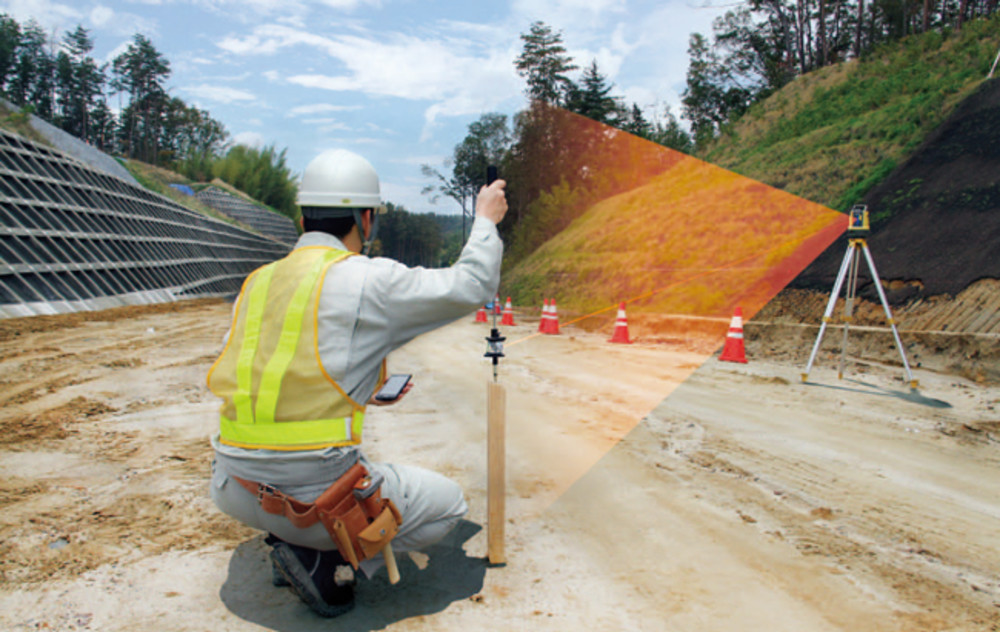
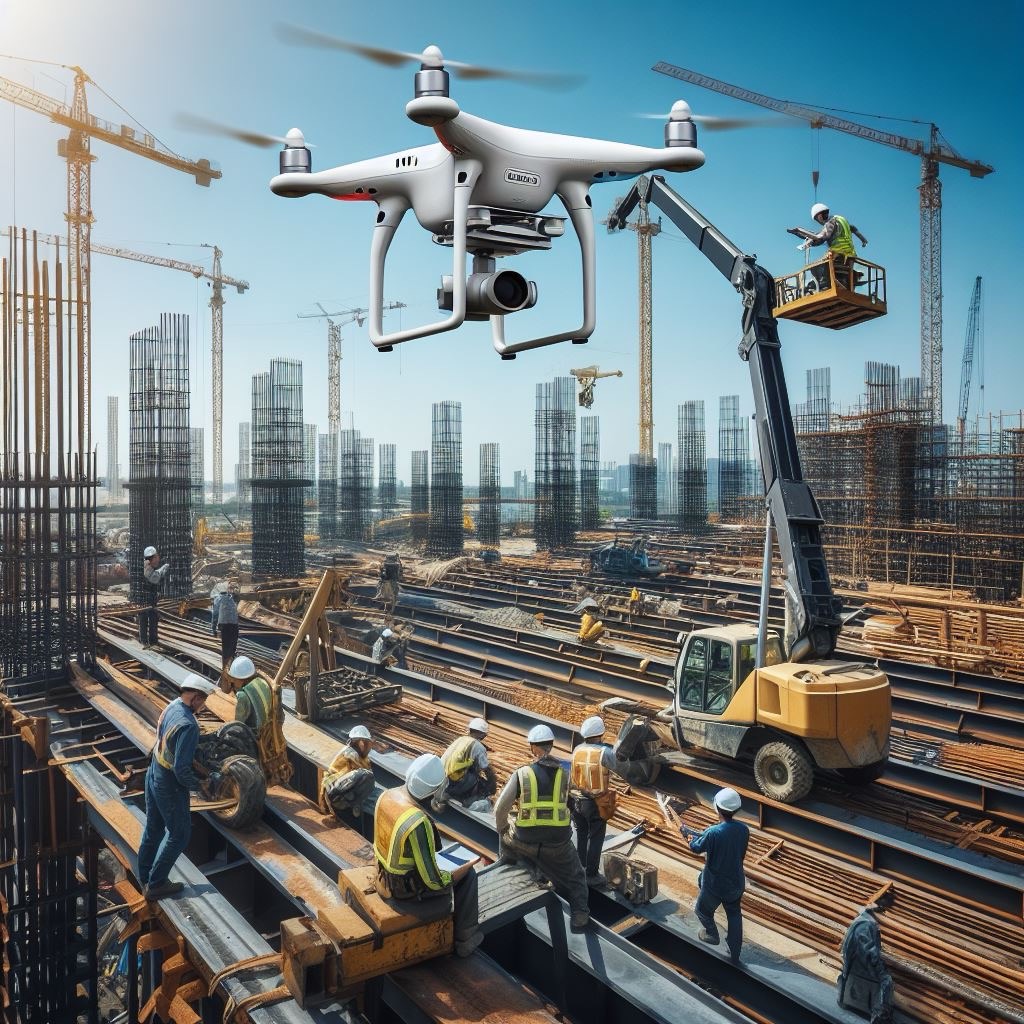
Is it too late to ask? What exactly does “safety first” mean?


Thanks for your hard work! This is Shirokuma.
We’ll be introducing this as part of our “Things You’re Too Embarrassed to Ask Now” series for the construction industry.
So, what exactly does “Safety First” mean in practice?
Besides helmets and safety harnesses, what other safety measures are there?
Surprisingly, not many people are aware of the rules and inspection procedures on-site.
Table of Contents
As a definition of "safety first,"
First, as a general premise, the reason why “safety first” is emphasized is that...
At construction sites, there is constant pressure regarding the construction schedule, quality, deadlines, and costs.
However, if an accident occurs, it not only results in the loss of human life, but also leads to project delays, damage to a company’s reputation, legal liability, and so on,
As a result, all elements are compromised.
That is precisely why “safety first” is a prerequisite for all achievements.
The construction industry has the highest number of accidents and workplace injuries of any industry, and
Human error—which leads to accidents—is generally considered difficult to prevent.
Therefore, if someone on the job site is not working safely, you must issue a caution or warning.
What Does “Safety First” Actually Mean? A Comprehensive Guide to Safety Measures at Construction Sites!
In the construction industry, the phrase “safety first” is used everywhere.
You see it all the time—written on helmets or displayed on signs at construction sites—but,
What does “safety first” actually mean, and what measures are being taken on-site?
1. “Safety First” is not just a slogan “ action ” .”
"Safety First" isn't just a slogan. At construction sites, in order to prevent accidents and disasters before they happen,
Various initiatives are being carried out every day. Workplace accidents are a serious issue that can be life-threatening, and
Since companies can be held accountable, safety management is considered the top priority on-site.
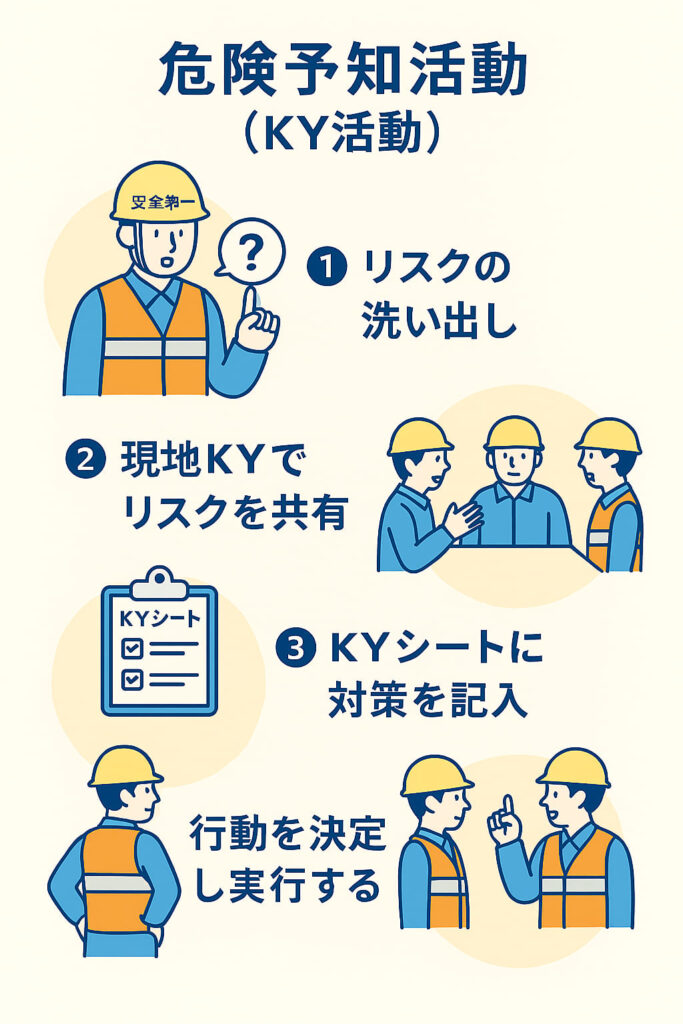
2. “KY Activities” to Prevent Human Error
"KY" (Hazard Prediction) activities involve reviewing the day's work tasks before starting work, and
This is an initiative in which the team discusses what kinds of risks there are.
This helps ensure that every worker develops a mindset of “taking personal responsibility for their own safety.”
- Sharing potential hazards using the KY sheet during the morning meeting every day
- Discuss "what the hazards are" and "how to prevent them" for each task
- Upon arriving at the work site, conduct a "solo on-site safety check" and double-check everything.
3. Safety Equipment: Measures to Prevent Accidents Before They Happen
Construction sites harbor a variety of hazards, such as slips, falls, being pinned, and electric shock.
To prevent these incidents, the following safety measures have been implemented:
Full-body harness for fall protection
- Full-body harnesses are required for work at heights, as they protect workers' lives in the event of a fall.
Scaffolding Safety Measures
- Handrails, crossbars, and toe boards are installed on the scaffolding to prevent falls.
- Scaffolding inspections are conducted daily, and any abnormalities are repaired immediately.
Measures to Prevent Electric Shock
- Install ground-fault circuit interrupters for power tools and wiring.
- As a general rule, work should be suspended in case of rain, or thorough waterproofing measures should be taken.
Safe Operation of Heavy Equipment
- Only certified operators may operate heavy equipment.
- To address blind spots, efforts are underway to station traffic controllers and install backup cameras.
4. Heatstroke Prevention: Working on construction sites in the summer can be a matter of life and death
Summers in Japan are hot and humid. The risk of heatstroke is particularly high at construction sites, where much of the work is done outdoors.
The following measures are commonly taken:
Thorough Hydration and Salt Intake
- Encourage workers to stay hydrated regularly.
- Sports drinks and salt candies will also be distributed.
WBGT Measurement of the WBGT
- We measure the “heat index,” which takes into account not only temperature but also humidity and radiant heat, and use it as a basis for deciding when to suspend work or take breaks.
Wearing cooling vests or air-conditioned clothing
- We provide work clothes with built-in fans (air-conditioned workwear) and vests filled with cooling gel to prevent body temperature from rising.
Establishment of Rest Areas
- Ensure there are cool places available, such as shaded areas or air-conditioned prefabricated buildings, and encourage workers to take frequent breaks.
- To rapidly lower body temperature, another method involves setting the temperature in a small private room quite low and combining this with the use of air-conditioned clothing.
5. Safety is “ Team ” is something we protect as a “team”
Safety measures are not enough if they rely solely on individual awareness. It is important to foster a safety culture throughout the entire workplace.
Recently, safety management utilizing ICT and IoT has been advancing, with sensors used to monitor workers' physical condition, and
Efforts to use AI for hazard prediction have also begun.
Summary
"Safety First" refers to the accumulation of specific actions taken to protect the lives of those working on-site.
Various measures—such as heatstroke prevention, the installation of safety equipment, and KY activities—are implemented on a daily basis at worksites.
For those interested in the construction industry or those who will be working on construction sites in the future,
Please make sure you understand the true meaning of “Safety First.” You can’t do good work without safety.


![[The Essentials of Site Supervision Series] 5 Golden Rules for "Perfect Concrete Placement"](https://ictkantoku.com/wp-content/uploads/2026/02/コンクリート打設の極意-完璧なコンクリートへの-5つのルール-1-150x150.jpg)
![[The Complete Roadmap for First-Year Site Supervisors] A 12-Month Plan to Take Your First Steps Toward Becoming a “Competent Supervisor” Without Getting Overwhelmed](https://ictkantoku.com/wp-content/uploads/2026/01/他の現場監督を置いて、未来のIT監督を目指す少年の絵-150x150.jpg)